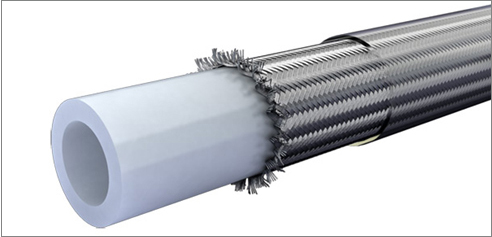
Steam is hotter than most people imagine it to be. At atmospheric pressure, water turns to steam at 100 degrees Celsius, but raises the pressure, and that figure climbs fast. Near 14 bar, saturated steam sits at roughly 198 degrees Celsius. A Teflon hose rated only for warm work has no business on a line like that. Pick the wrong one, and the failure does not show up as a quiet drip. It shows up as a scald.
So choosing a Teflon hose for steam or hot fluid comes down to reading two numbers and matching them honestly. Temperature and pressure. Get those right and the other choices get much simpler. Here is how to work through it.
Why a Teflon Hose Handles Heat So Well
PTFE, the material sold under the Teflon name, melts at about 327 degrees Celsius. In service, most makers rate it for continuous use up to around 260 degrees Celsius. That headroom is why it turns up on hot oil, thermal fluid, and steam lines where rubber would crack. PTFE also does not age in heat the way rubber does, so it holds its shape over long hot runs. Its bore is smooth and slick, so hot fluid flows with little drag and leaves little behind. It resists aggressive chemicals too, which matters when the fluid is not clean water. Few other tube materials match that on a hot, hard-working line.
See also: How Technology Is Revolutionizing Financial Transactions
Read the Steam Pressure and Temperature First
This is the part buyers skip, and it catches them out later. Saturated steam has a fixed link between pressure and temperature. Near 14 bar, the steam runs at about 198 degrees Celsius. Near 41 bar, it approaches 260 degrees Celsius, the ceiling for most PTFE.
So a hose can sit inside its temperature limit and still be wrong, because it loses pressure capacity as it gets hotter. That drop is real and steep. One maker rates a 50 per cent cut in working pressure once the line reaches 190 degrees Celsius. Pull the de-rating chart for the exact hose and read its pressure at your working temperature, not the headline figure on the box. If the maker has no de-rating data, treat that as a reason to look elsewhere.
Smooth Bore or Convoluted Teflon Hose
Two builds dominate. Smooth-bore PTFE has a plain, straight tube, gives the best flow, holds higher pressure, and drains condensate instead of trapping it. For steam and most hot fluid lines, it is the usual pick. The convoluted PTFE has a rigid tube that bends more easily and fits tight runs. It carries less pressure, though, and can hold pockets of liquid in the grooves.
Two more points help here. Fast-moving steam or dry fluid can build up static inside the tube. A conductive liner bleeds that charge to the metal ends, so ask for one on steam duty. Small smooth bore sizes also hold full vacuum, while larger runs may need a support coil to stop the bore collapsing.
Hot Teflon Hose in Food and Pharmaceutical Plants
Plants that move milk, juice, or medicine lean on PTFE for a second reason. The bore is non-stick, so the product does not cling to it, and cleaning is quick. Many of these lines are sterilised with steam in place, where steam runs through the assembly at around 150 degrees Celsius between batches. A food-grade PTFE tube, made from FDA-approved resin, takes that heat without tainting the next batch. If your line carries anything people eat, drink, or inject, ask for the food-grade liner and keep the certificate on file.
The Burn Risk People Forget
Here is the hazard that gets overlooked. A stainless steel braid carries heat straight to the surface. Touch a braided hose running live steam, and it can burn skin in an instant. A fibre braid or a silicone cover lowers that surface heat and adds some protection. Specify one on any line people work near.
Routing matters too. Keep hot hoses clear of walkways and add a guard where hands or arms might land. Steam lines also swing between hot and cold, and that cycling is hard on a hose. Some PTFE builds are not rated for repeated steam and cold water shocks, so check that the one you choose can take the swing. Fit a whip restraint as well, because a hot hose that lets go is far worse than a cold one.
Get the Fittings and the Order Right
The hose is only half the assembly. PTFE needs fittings matched to its tube and its temperature. The safest route is to take both from the same maker, so the seal and the crimp suit each other. A mismatched fitting on a hot line will leak under heat. Before you place an order, settle a short list of facts with the supplier:
- The fluid, and whether it is steam, hot water, oil, or a chemical
- The working temperature and the peak temperature
- The working pressure, checked against the de-rating chart
- Smooth bore or convoluted, and conductive or plain
- The cover and any guarding for people nearby
- End fittings and the length you need
Those answers remove most of the guesswork. The recognised PTFE hose specification, SAE 100R14, gives a common baseline, but the application sets the real limits. Spend ten minutes on the numbers now, and you save yourself a failure on a live steam line later.
